When the Russian Dolls Collapse
Your job is just one expression of you: not the full story.

I was on a call with a client, walking through some feedback she'd gotten on a presentation. Nothing especially catastrophic: a few notes, the kind everyone gets. But watching her, you'd have thought the verdict was on her whole life.
I said something I'd never quite put into words before // when we get feedback on a presentation, we collapse the circles.
She finished the sentence before I could. "Going to get fired."
That's the tell. She didn't hear "this slide needs work." She heard something about who she is.
Here's the model, and I'll admit I'm still building it.
Picture yourself as a set of concentric rings.
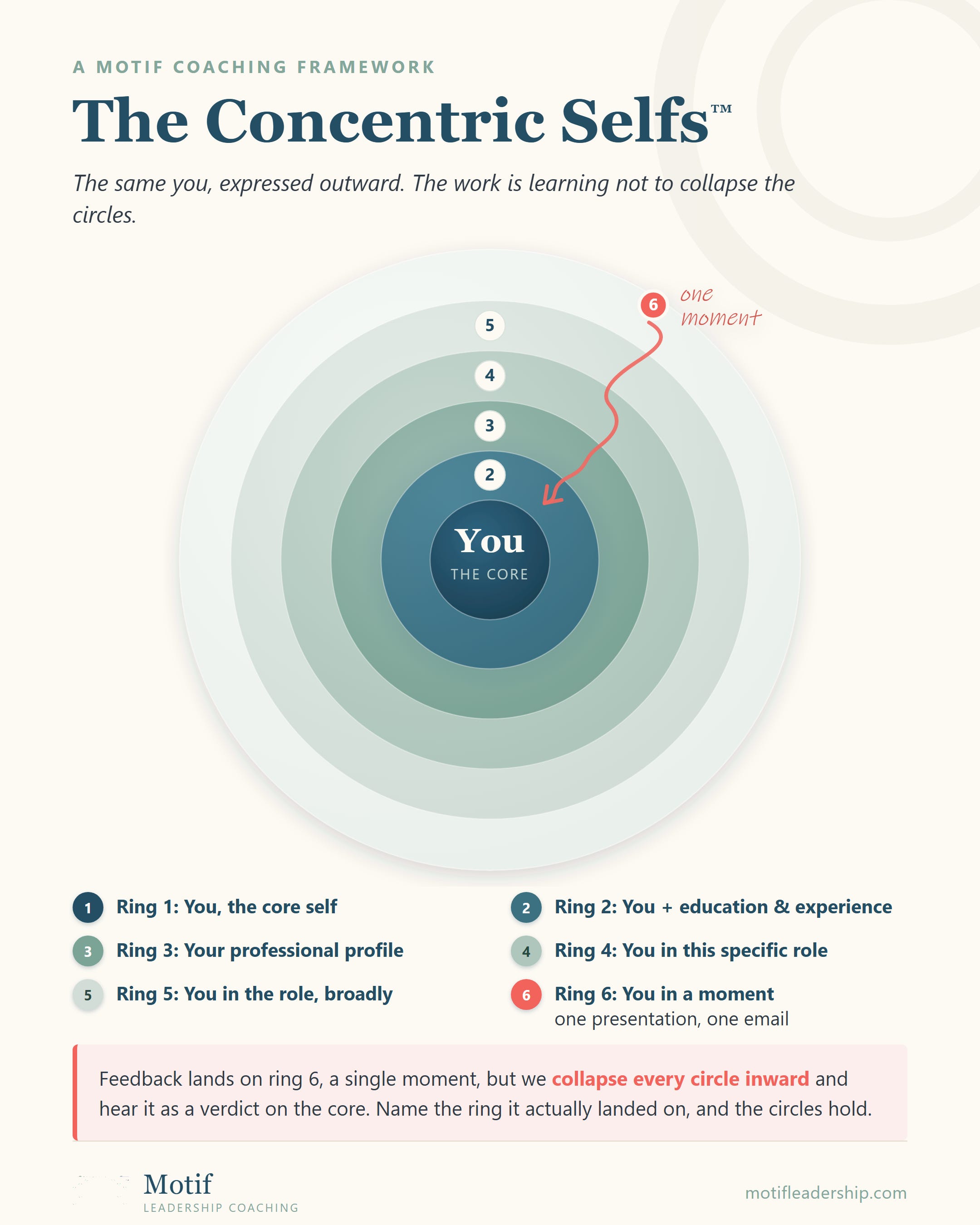
At the very center is you: the part that doesn't change when your job does. Around it, wider and wider, are the outer expressions of you: you plus your education and experience. You as a professional. You in one particular role. You in one specific meeting, on one specific Tuesday, presenting one specific deck.
Same person the whole way out. Just expressed at different removes from the center.
The rings are connected, but distinct. Not one in the same. A note on work product should land on the outermost ring // one moment, one artifact: and stop there.
But under pressure, the rings collapse. Feedback that belongs on the outside edge slams all the way to the core. "This chart is confusing" becomes "I'm bad at my job" becomes "I'm not a good person." The circles compress into a single point, and that point is you.
Last week I wrote that the work of a good career is taking work out of the center of your life: recalibration, not more or less. Here's the part I left out: the center doesn't stay empty. It keeps trying to re-fill with work, because we let a critique of the outermost ring rewrite the innermost one.
That's why "it's just a job" is such useless advice. Of course it's just a job. The problem was never the job. The problem is that the circles collapsed, and a bad meeting got a vote on whether you're a good person.
So the practice isn't detachment. It's learning to reorient in real time: keeping the rings apart on purpose. When the next piece of feedback lands, the only question worth asking is: which ring does this actually belong to?
Almost always, it's an outer one.
One deck. One email. One moment. Let it land there, and stay there.
The dial from last week was about direction: how you want to be ambitious. This is what protects it. You can aim your ambition wherever you like, but if every stray note collapses into your core, the center fills back up with work no matter where you pointed the dial.
Keep the circles open. That single moment is just the outer ring.
You are still the center.